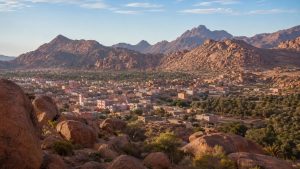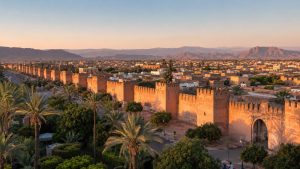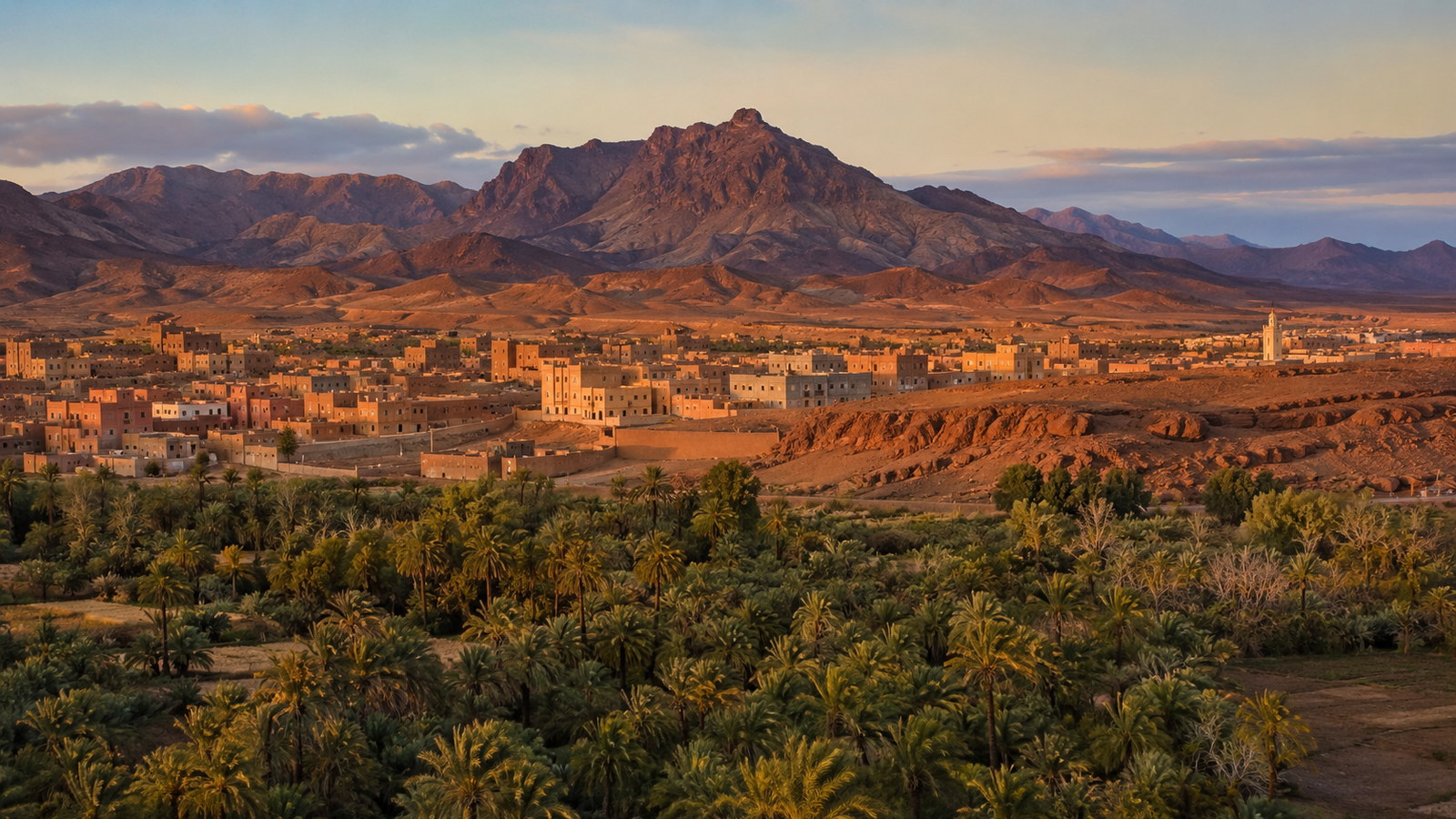
This Zagora Travel Guide introduces one of southern Morocco’s most evocative stopping points: a palm-fringed town where the Draa Valley meets the open, mineral landscapes that lead toward the Sahara. Zagora is not a resort built around one landmark. Its appeal comes from the journey itself—earthen villages, date-palm gardens, mountain silhouettes, traditional crafts and the sense of continuing south along an old caravan corridor.
Travelers often arrive from Marrakech or Ouarzazate, then use Zagora as a base for Tamegroute, Tinfou, M’Hamid El Ghizlane and longer 4×4 journeys to Erg Chigaga. The city is also a comfortable place to slow down between road-trip stages, especially when a riad, garden or palm-grove lodge is part of the experience.
The most important planning detail is geographical: Zagora is a gateway to the desert, but the town is not beside the towering dunes seen around Merzouga. Small dunes can be visited near Tinfou, while the large, remote landscapes of Erg Chigaga lie farther south beyond M’Hamid and normally require an experienced driver and a suitable 4×4. For Erg Chebbi specifically, use our Merzouga Sahara Desert Travel Guide.
Use this Zagora Travel Guide to choose the right experiences, decide how long to stay, understand the seasons, plan realistic road times and connect the destination with the rest of your Morocco itinerary.
Zagora also works as a decision point in a wider Morocco itinerary. Travelers can return north through Ouarzazate, continue toward a remote Erg Chigaga camp, or connect the Draa Valley with longer journeys across the south. The right choice depends on road time, season, mobility and whether culture or high dunes is the main priority.
This expanded guide is designed for independent planners and guests considering a private tour. It distinguishes verified geography from common marketing shortcuts, includes realistic itinerary options and explains how to support local guides, craftspeople and oasis communities.
Zagora Travel Guide at a Glance
- Best for: Draa Valley scenery, Amazigh heritage, earthen architecture, pottery, road trips and remote desert expeditions.
- Recommended stay: two nights for Zagora and nearby sights; three or more for a relaxed Erg Chigaga extension.
- Most comfortable seasons: spring and autumn; winter days can be pleasant but nights are cold.
- Nearest easy desert stop: Tinfou Dunes, a small dune field south of Zagora.
- Major remote desert experience: Erg Chigaga via M’Hamid, with guided 4×4 access and an overnight camp.
- Useful bases: central Zagora, Amezrou and palm-grove lodges; M’Hamid for expeditions farther south.
- Travel style: private road trip or organized multi-day journey is usually the most comfortable option.
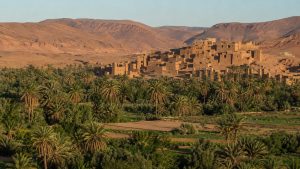
Traditional kasbahs rise above the date-palm oasis along the Draa Valley road to Zagora.
Why Visit Zagora?
A strong Zagora Travel Guide should begin with the destination’s real character. Zagora rewards travelers who enjoy transitions: green palm groves against dry mountains, lively market streets beside quiet garden paths, and cultivated oases opening onto stony desert plateaus. It feels less polished than Morocco’s major tourist cities, which is precisely why many visitors remember it.
The town also gives context to the Draa Valley’s long history of exchange. Its well-known ‘Tombouctou 52 jours’ sign is a modern landmark that recalls the memory of trans-Saharan caravan routes rather than a surviving mileage marker from antiquity. Nearby ksour, kasbahs, workshops and irrigation landscapes reveal a region shaped by trade, agriculture and adaptation to an arid climate.
The official Moroccan tourism overview presents Zagora, Ouarzazate and Tinghir as gateways to varied valleys and desert scenery. Visit with time to walk, talk with local craftspeople and look beyond a single camel photograph.
Where Is Zagora Located?
This Zagora Travel Guide places the town in southeastern Morocco, in the Drâa-Tafilalet region along the Draa Valley south of Ouarzazate. By road it is roughly 350 km from Marrakech and about 160 km from Ouarzazate. Journey times vary with mountain traffic, weather, roadworks and stops; allow a full travel day from Marrakech rather than treating the route as a simple transfer.
The classic approach crosses the High Atlas, passes Ouarzazate and descends through the Anti-Atlas toward Agdz before following the Draa Valley south. Palm groves, kasbahs and ochre villages make the drive part of the experience. Shade Explore’s 5-day desert tour from Marrakech shows how Zagora can fit into a broader southern circuit without rushing every stop.
- From Marrakech: approximately 350 km; commonly 6.5–8 hours before sightseeing stops.
- From Ouarzazate: approximately 160 km; commonly 2.5–3 hours.
- From Agdz: approximately 95 km; commonly around 1.5 hours.
- From M’Hamid El Ghizlane: approximately 95 km; allow around 1.5–2 hours depending on stops and road conditions.
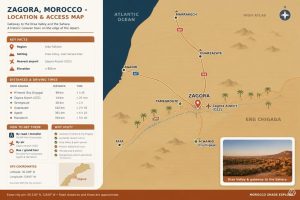
Zagora location and access map showing the main routes from Marrakech, Ouarzazate and Agadir to the gateway of the Sahara.
Zagora Desert, Tinfou or Erg Chigaga: Know the Difference
This Zagora Travel Guide separates three landscapes that tour descriptions sometimes group under the phrase ‘Zagora desert.’ Understanding the difference prevents disappointment and helps you choose the right itinerary.
The Landscapes Around Zagora
Around the town, expect palm groves, dry river landscapes, dark mountain ridges and hamada—wide, stony desert plains. These views are dramatic and unmistakably pre-Saharan, but they are not an endless sea of high sand dunes.
Tinfou Dunes
Tinfou is a small, isolated dune area south of Zagora and near Tamegroute. It is useful for a short sunset stop, a brief camel experience or a first introduction to sand. It should not be marketed as equivalent to Erg Chigaga or Erg Chebbi.
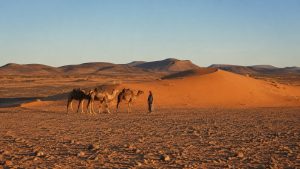
The Tinfou dune offers a first desert experience a short drive from Zagora.
Erg Chigaga
Erg Chigaga is a remote dune system reached beyond M’Hamid El Ghizlane, usually by guided 4×4 or as part of a trek. The off-road journey, desert camp, sunset and night sky create the region’s most immersive Sahara experience. The official tourism site also distinguishes the Draa Valley, Tinfou and Chigaga landscapes.
Zagora or Merzouga?
Choose Zagora for the Draa Valley, Tamegroute, caravan-route atmosphere and access to remote Erg Chigaga. Choose Merzouga when your priority is reaching high, photogenic Erg Chebbi dunes directly from a village with more developed desert infrastructure. Both are rewarding, but they are not interchangeable.
Best Things to Do in Zagora
The best things to do in Zagora combine the town, nearby oasis settlements and one carefully chosen desert experience. This Zagora Travel Guide recommends building variety into the schedule instead of spending every hour in a vehicle.
1. Explore the Draa Valley Palm Groves
Walk with a local guide through date-palm gardens and small agricultural plots to understand how shade, water channels and layered planting sustain life in the oasis. Paths can be confusing and cross private working land, so local guidance improves both access and etiquette. Early morning and late afternoon offer softer temperatures and better light.
2. Photograph the ‘Tombouctou 52 Jours’ Sign
The painted sign at the entrance to Zagora has become the town’s best-known photo stop. Treat it as a symbolic reference to the long caravan journey toward Timbuktu. A quick picture is enough; the deeper story appears in the valley’s trade routes, settlements and cultural memory.
3. Discover Amezrou and Its Craft Heritage
Amezrou, near Zagora, is associated with an old Jewish quarter and a tradition of metalwork and jewellery. Visit respectfully with someone who can explain the neighbourhood’s layered history. Ask before photographing residents or workshops, and let craftspeople describe the materials and techniques rather than assuming that every object is antique or locally made.
4. Visit Ksar Tissergate
Tissergate is a compact earthen settlement in the palm-grove landscape north of Zagora. Its shaded passages and defensive form help visitors understand pre-Saharan architecture on a human scale. A local museum may offer additional context when open; verify access and hours on the day of your visit.
5. Experience Zagora’s Weekly Souk
The large weekly market is one of the best places to see the region’s everyday economy, from dates and vegetables to household goods, livestock areas and desert clothing. Wednesday and Sunday are commonly cited market days, but schedules and locations can change. Confirm locally, arrive in the morning and keep photography discreet.
6. Visit Tamegroute’s Library and Pottery Workshops
Tamegroute is known for the historic Nasiriyya religious and learning complex, its manuscript tradition and distinctive green-glazed pottery. Access to religious spaces or collections may be limited, and opening patterns can change. Dress respectfully and follow local instructions. The official Moroccan tourism culture page provides useful background on the region’s earthen heritage and Tamegroute library.
At the pottery workshops, look for the full process—from clay preparation and wheel work to glazing and firing. Buying directly from a transparent workshop supports local knowledge, but ask whether the piece is food-safe if you intend to use it for cooking or serving.
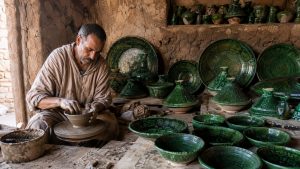
Tamegroute is renowned for its distinctive green-glazed pottery, handmade in local family workshops.
7. See the Tinfou Dunes at Sunset
Tinfou works best as a short landscape stop, especially when combined with Tamegroute. The warm light can be beautiful, but set expectations correctly: this is a small dune feature surrounded by rocky terrain, not a substitute for a multi-day Sahara expedition.
8. Take a Guided Excursion Toward M’Hamid
The road south to M’Hamid reveals increasingly arid scenery and settlements shaped by the desert frontier. M’Hamid is a practical departure point for Erg Chigaga. Use a reputable operator for the off-road section, carry sufficient water and avoid attempting remote tracks in an ordinary rental car.
9. Spend a Night in a Desert Camp
A well-planned camp stay can include a 4×4 transfer, sunset walk, dinner, music, stargazing and sunrise. Ask exactly where the camp is located, how long the off-road transfer takes and what ‘luxury’ includes. Private bathrooms, heating, electricity and mobile coverage vary widely. Choose a camp that manages water, waste and generator use responsibly.
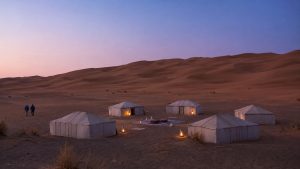
An excursion from Zagora through M’Hamid leads to the remote dunes and desert camps of Erg Chigaga.
10. Enjoy a View Toward Jebel Zagora
The dark ridge above the oasis creates a striking backdrop at sunrise and sunset. Viewpoint access and trail conditions can vary, so ask a local guide or accommodation for the safest current option. Carry water and avoid exposed walks during the hottest part of the day.
Best Desert Experiences from Zagora
This Zagora Travel Guide treats a desert tour as a choice, not a single standard product: it can be as simple as a sunset near Tinfou or as ambitious as several nights crossing remote terrain. Match the experience to your available time, mobility and tolerance for long drives.
Short and Easy
- Palm-grove walk followed by sunset near Jebel Zagora.
- Tamegroute workshops plus a short Tinfou stop.
- Optional camel ride of limited duration, with 4×4 access available for travelers who prefer not to ride.
Full-Day Adventure
- Early departure toward M’Hamid with guided 4×4 exploration.
- Picnic or prepared lunch in an appropriate desert setting.
- Return after sunset only with a driver experienced on the route.
Overnight Erg Chigaga Journey
- Off-road transfer with planned scenic and cultural stops.
- Sunset, dinner, campfire when conditions permit and stargazing.
- Sunrise and return toward M’Hamid or Zagora the following day.
- Two nights for travelers who want a slower pace, walking time or deeper desert immersion.
History, Caravan Memory and Oasis Culture
Zagora is often introduced through the image of a caravan leaving for Timbuktu, but its cultural identity is broader than one famous sign. The town sits within a chain of oasis settlements where agriculture, trade, religious learning and mobility have shaped daily life for generations. Understanding that context turns a scenic stop into a more meaningful visit.
The Draa corridor connected communities on both sides of the mountains and farther south. Dates, salt, textiles, animals, metalwork and knowledge moved through the region, while fortified villages protected families, stores and water systems. Modern roads have transformed travel, yet the memory of movement remains visible in place names, markets, architecture and family histories.
Caravan Routes Without the Mythology
The ‘Tombouctou 52 jours’ sign is best read as a symbol of Zagora’s caravan memory. It evokes the immense distance between the Draa Valley and the Sahel, but it should not be treated as a precise contemporary itinerary or an unchanged historical road marker. Caravan travel varied with water, weather, security and the animals carrying the loads.
A responsible guide uses the sign to open a conversation about exchange rather than presenting the past as an exotic adventure. Ask how routes affected settlement patterns, languages and crafts, and remember that trans-Saharan trade included difficult histories as well as commercial and cultural connections.
Ksour, Kasbahs and Earthen Building
Throughout the valley, compact ksour and fortified kasbahs were built with earth, timber and local stone. Thick walls moderate temperature, covered lanes create shade and dense construction protects limited agricultural land. Tissergate is one of the most accessible places near Zagora to observe these principles, but it remains a lived environment rather than an outdoor film set.
Rain, changing lifestyles and maintenance costs make earthen heritage vulnerable. Use marked routes, do not climb unstable walls and pay local entry or guiding fees when requested. The official regional tourism description of Ksar Tissergate provides useful background before a visit.
Tamegroute as a Centre of Learning
Tamegroute’s significance comes from religious scholarship, manuscript culture and the Nasiriyya tradition as well as pottery. Not every room or collection is continuously open to casual visitors, and access can change around religious events. Modest clothing, quiet behaviour and a local guide help visitors approach the site appropriately.
The village’s ceramic workshops add a living craft dimension. The characteristic glazes vary in tone and texture because pieces are made and fired by hand. Rather than searching for identical souvenirs, look for evidence of the process and ask how the workshop organizes production, pricing and shipping.
Amazigh, Arab and Saharan Identities
The Draa Valley cannot be reduced to a single cultural label. Amazigh heritage, Arabic-speaking communities, Saharan connections, religious lineages and the memory of Jewish neighbourhoods all contribute to the region. Identities are lived and evolving, not museum categories.
Listen to the terms people use for themselves, avoid intrusive questions and do not photograph children or private homes without clear permission. A thoughtful local guide can explain language, clothing, food and architecture while avoiding stereotypes.
Draa Valley Landscapes, Water and Date-Palm Agriculture
The green ribbon visible around Zagora is not a natural garden requiring no work. It is a carefully managed oasis landscape where water, shade and soil have been organized under arid conditions. Walking through it with local context is one of the most valuable experiences in this Zagora Travel Guide.
Palm groves also face pressure from drought, changing water availability, plant disease, rural migration and land fragmentation. Visitors can support the landscape by staying on paths, avoiding waste and choosing guides or lodges that work with local communities.
Traditional kasbahs rise above the date-palm oasis along the Draa Valley road to Zagora.
How the Oasis Creates Layers of Shade
Date palms form the upper canopy. Fruit trees and smaller crops can grow beneath them, where reduced sun and wind slow evaporation. The exact pattern varies from garden to garden, but the layered system explains why a narrow cultivated corridor can remain productive beside barren-looking mountains.
The most photogenic viewpoint is not always the most informative. A guided walk can reveal irrigation channels, field boundaries, drying dates, composting practices and the seasonal work that sustains the grove.
Water Is a Working Resource
Channels and wells are part of an active agricultural system. Do not wash in them, block them for photographs or assume every path is public. Water scarcity is a practical reality, so showers, swimming pools and camp services should be used with restraint even when a hotel advertises abundant comfort.
Travelers can refill a reusable bottle with treated water supplied by their accommodation and avoid leaving single-use plastic at remote stops. Ask camps how drinking water and wastewater are managed rather than judging sustainability only by décor.
Dates and the Seasonal Rhythm
Dates are an important food and source of income across the valley. Varieties differ in colour, texture, sweetness and storage quality. When buying at the souk, ask for a small taste, compare grades and confirm the price by weight before ordering a large quantity.
Harvest timing varies, and a visit outside the main season can still be rewarding. Markets, gardens and kitchens show how dates are stored, served with tea and incorporated into everyday hospitality throughout the year.
Responsible Walks in the Palm Grove
Wear closed footwear, carry water and follow a guide who knows which paths are appropriate. Palm groves can contain irrigation ditches, uneven surfaces, insects and working animals. After rain, some paths become muddy even when the surrounding desert appears dry.
Keep groups small, lower voices near homes and avoid drones unless all legal and local permissions are clear. Purchasing dates, pottery or guiding services directly can create more local value than a hurried roadside photo stop.
Photography Guide to Zagora and the Draa Valley
Zagora offers strong photographic contrasts: palms against dark ridges, geometric adobe walls, market colours and long desert shadows. The best images come from accurate planning and respectful access rather than inventing scenes or placing people into staged ‘nomad’ roles.
Dust and heat affect equipment. Carry a sealed bag, lens cloth and spare battery, and change lenses indoors or inside a vehicle when wind is strong. A simple prime or standard zoom is often more practical than a heavy kit during walks and transfers.
Best Light for the Draa Valley
Morning light can reveal texture in the palm grove and villages, while late afternoon warms earthen walls and mountain faces. Midday light is harsh but can work inside shaded passages at Tissergate or for graphic patterns in pottery workshops.
Use viewpoints and established paths instead of walking into agricultural plots. If a terrace belongs to a café, lodge or family, ask before setting up equipment and buy something when appropriate.
Photographing Tamegroute and Workshops
Religious sites may prohibit photography in certain spaces. Put the camera away immediately when asked. In workshops, obtain permission from the artisan before photographing faces or close-up work, and make a purchase or pay an agreed photography fee if that is the local practice.
A sequence showing clay, hands, glazing, kiln and finished ceramics tells a stronger story than a single shelf of products. Keep captions factual and do not label every green vessel as ancient.
Desert Sunsets and Night Skies
At Tinfou, compose honestly so the image does not suggest an enormous erg. At Erg Chigaga, dunes provide wider horizons and cleaner layers, but wind can erase tracks and reduce visibility quickly. Follow the guide’s return time and carry a headlamp after sunset.
For stars, use a stable support, a wide lens and a dim red light. Avoid shining bright phones or torches into other guests’ exposures. Moon phase, clouds, dust and camp lighting determine what is possible, so no operator can guarantee a perfect Milky Way photograph.
People, Privacy and Drones
Always ask before photographing identifiable people. A friendly conversation does not automatically equal consent to publish an image commercially. Children require permission from a responsible adult, and a refusal should end the discussion without pressure.
Drone rules in Morocco are restrictive and equipment can create legal or privacy problems. Do not arrive expecting to fly. Verify current national requirements through official channels well before travel and respect any local restrictions even when an online photograph suggests that others have flown there.
Zagora for Couples, Families, Solo Travelers and Limited Mobility
The same itinerary does not work for every traveler. Road time, temperature, camp access and walking surfaces should be adjusted before booking. A private journey is especially useful around Zagora because it can balance cultural stops with rest rather than forcing everyone into one desert template.
Couples and Honeymoon Travel
Choose a quiet palm-grove lodge, private driver and small camp with a clearly described room category. A private dinner or sunset walk is more reliable than asking for vague ‘romantic decoration.’ Confirm whether the camp is secluded or part of a large cluster before paying a premium.
Two nights in the region reduce fatigue and allow one slow morning. Combine Zagora with Aït Ben Haddou or Ouarzazate rather than spending consecutive days returning over the same mountain road.
Families With Children
Break the Marrakech drive with an overnight stop and schedule outdoor activities early or late. Ask for age-appropriate child restraints, shade, flexible meals and rooms close together. Short camel rides and a 4×4 camp transfer are often easier than a long trek.
Children should not wander near irrigation channels, unstable earthen walls or dunes without supervision. Carry familiar snacks, oral rehydration supplies and any essential medication because choices narrow south of Ouarzazate.
Solo Travelers
Zagora is generally relaxed, and solo visitors can stay in a central riad or join a reputable small-group excursion. Arrange late transfers in advance, share the remote-camp itinerary with someone and keep control of identification and money.
Joining the cheapest street offer is not the only way to meet people. A guided palm-grove walk, pottery visit or established camp can provide social contact with clearer safety and service standards.
Travelers With Limited Mobility
Earthen villages, palm-grove paths and sand are uneven, and many riads have stairs without elevators. Ask for exact information: number of steps, bathroom layout, distance from vehicle to room and whether staff can safely assist. ‘Accessible’ can mean very different things.
A 4×4 sunset viewpoint, ground-floor lodge room and visits to open workshop areas may replace long walks or camel rides. Discuss mobility needs privately and in detail before confirming the itinerary.
Budget, Money, Connectivity and Local Etiquette
Zagora can suit different budgets, but the lowest advertised price often excludes the remote transfer, camp category, meals or private guiding that defines the experience. Compare complete itineraries and written inclusions rather than daily prices alone.
What Determines the Cost
The main variables are private versus shared transport, vehicle type, number of travelers, accommodation standard, camp location, length of the off-road transfer, meals, local guides and whether the trip returns to Marrakech or continues elsewhere. Erg Chigaga usually costs more than a Tinfou stop because it requires more time, fuel and specialized access.
Request a quote that names every night and major activity. Confirm taxes, drinks, lunches, gratuities and single-room supplements. A transparent operator should also explain cancellation terms and the alternative plan if weather affects the tracks.
Cash, Cards and ATMs
Carry Moroccan dirhams for souks, tips, simple cafés and small workshops. ATMs are available in Zagora, but a machine can be offline or unable to serve a foreign card. Withdraw before leaving for M’Hamid or a remote camp and keep small notes separate from your main wallet.
Cards are more common at larger hotels than in villages. Never rely on a camp to process a last-minute balance without confirming the method in writing.
Mobile Coverage and Wi-Fi
Coverage is generally easier in town than on the tracks, and a camp’s Wi-Fi may depend on a mobile signal or generator. Download maps, reservation details and contact numbers before leaving Zagora. A local SIM can be useful, but no provider covers every remote area.
Tell family that you may be offline overnight. A professional desert operator should have its own communication and contingency procedures rather than relying on a guest’s phone.
Language and Courtesy
Arabic and Amazigh languages are part of daily life, while French is widely useful in tourism and some guides speak English or Spanish. A greeting, thanks and patient tone matter more than perfect vocabulary. Ask before entering workspaces or homes.
Dress is a personal choice, but light, modest clothing is practical for sun and cultural settings. Public affection should be discreet, and visitors should avoid treating traditional dress as a costume prop.
Tipping and Shopping
Tips are customary for good service but should reflect the length and quality of the work. Ask your operator whether guides, drivers and camp staff are tipped separately. Carry small notes and give directly rather than assuming a group collection reaches everyone.
In shops, polite negotiation may be expected, but not every price is flexible. Compare quality, ask about origin and decline calmly. For pottery, request secure packing and discuss shipping risk before purchasing large pieces.
Best Time to Visit Zagora
This Zagora Travel Guide favors spring and autumn for balanced temperatures, but each season changes the experience. Read Shade Explore’s complete Best Time to Visit Morocco guide when combining Zagora with mountain, coastal or northern destinations.
Spring: March to May
Spring is generally comfortable for palm-grove walks, village visits and camping. Daytime heat increases toward late May, while wind can occasionally carry dust or sand. Easter and holiday periods may be busier, so reserve preferred camps in advance.
Autumn: September to November
Autumn brings more comfortable conditions after the summer heat. Date harvest activity can add interest in parts of the Draa Valley. October and November are popular for desert trips, making early booking sensible for small, quality properties.
Winter: December to February
Winter days can be sunny and pleasant, but nights in the desert may feel very cold. Pack a warm layer, hat and sleepwear, and ask whether the camp provides adequate bedding or heating. Short daylight hours also affect driving plans.
Summer: June to August
Summer heat can be extreme. If travel is unavoidable, schedule activity near sunrise or late afternoon, stay in air-conditioned accommodation and avoid exposed walks at midday. Confirm that any camp or vehicle is properly equipped for the season.
How Many Days Should You Spend in Zagora?
A realistic Zagora itinerary depends on whether you want the town and nearby sights or a remote desert journey. One night is a transit stop; two nights provide a meaningful introduction; three or more are preferable when Erg Chigaga is included.
One Night: Essential Stopover
- Arrive through the Draa Valley in the afternoon.
- See the famous sign and walk near the palm groves.
- Stay in Zagora or Amezrou and continue south or north the next morning.
Two Nights: Recommended First Visit
- Day 1: Draa Valley arrival, Zagora orientation and sunset.
- Day 2: Tissergate, Tamegroute workshops and Tinfou, with time for the souk when schedules align.
- Day 3: depart after breakfast without compressing every experience into one day.
Three or Four Nights: Zagora Plus Erg Chigaga
- First night in Zagora or a palm-grove lodge.
- Second night in a remote desert camp beyond M’Hamid.
- Optional additional night for walking, photography, rest or a less hurried return.
- Link the route with Aït Ben Haddou, Ouarzazate or another southern destination rather than driving directly back and forth.
How to Get to Zagora
The journey is a central part of any Zagora Travel Guide because road conditions and stop choices shape the day. Zagora has regional transport, but a private transfer or organized tour is easiest when you want to explore villages, viewpoints and desert tracks rather than simply reach the bus station.
From Marrakech
Most road itineraries cross the Tizi n’Tichka route, pass Ouarzazate and continue through Agdz and the Draa Valley. Do not plan a same-day return. A minimum two-day trip is possible but drive-heavy; three to five days creates a better balance of travel and discovery.
From Ouarzazate
Ouarzazate is the most convenient major starting point. The route via Agdz is scenic and can include kasbah or palm-grove stops. Travelers approaching from Marrakech may also visit the UNESCO-listed ksar using our Ait Ben Haddou Travel Guide and the official UNESCO site record.
Bus, Shared Taxi or Private Driver
Buses and shared taxis can reduce costs, but timetables, departure points and luggage rules should be verified locally. A private driver costs more but allows scenic stops, hotel pickup and safer coordination with a remote camp transfer. Self-driving works for the paved route; never take a standard rental vehicle onto deep desert tracks unless the contract and conditions explicitly allow it.
Where to Stay in Zagora
Where you stay changes the rhythm of the trip. This Zagora Travel Guide recommends choosing an area before choosing a hotel category, then checking recent reviews for cleanliness, air-conditioning or heating, parking and meal quality.
Central Zagora
Best for travelers using public transport, visiting the souk or wanting restaurants and practical services nearby. Expect more road activity than in the palm-grove areas.
Amezrou and the Palm Groves
Riads and lodges around Amezrou can feel calmer and more atmospheric. Confirm access if arriving after dark and ask whether the property can arrange a guided walk through the gardens.
Tamegroute or M’Hamid
Stay farther south when pottery, village life or an early Erg Chigaga departure is the priority. M’Hamid reduces the paved-road portion before the off-road desert transfer.
Desert Camps
Ask for the exact camp location—not only the word ‘Zagora.’ Clarify whether the camp is near Tinfou, around M’Hamid or at Erg Chigaga, because the scenery, transfer time and level of remoteness differ substantially.
What to Eat in Zagora
This Zagora Travel Guide also makes room for food, because meals in the Draa Valley are an opportunity to experience southern Moroccan hospitality at an unhurried pace. Look for seasonal, freshly prepared dishes and remember that remote camps usually offer a set menu rather than restaurant-style choice.
- Local dates and date products, especially during the autumn harvest season.
- Slow-cooked vegetable, chicken, lamb or beef tagines.
- Couscous, commonly associated with Friday family meals but available more widely in restaurants.
- Fresh bread, olives, salads and seasonal fruit.
- Mint tea and regional herbal infusions.
- Vegetarian meals when requested in advance; clearly communicate allergies before a camp departure.
What to Pack for Zagora and the Desert
A practical Zagora Travel Guide must account for strong sun, dust, large temperature changes and limited shopping once a remote excursion begins. Pack light, but do not omit layers or essential medication.
- Breathable clothing that covers shoulders and legs for sun protection and respectful village visits.
- Warm fleece or jacket for winter evenings and pre-dawn camp hours.
- Comfortable closed shoes plus sandals for the lodge or camp.
- Sun hat, sunglasses, high-SPF sunscreen and lip balm.
- Reusable water bottle; follow your operator’s guidance on safe refilling.
- Scarf or buff for wind and dust, without treating local dress as a costume.
- Power bank, headlamp, spare camera batteries and a protective bag for electronics.
- Personal medication, basic first-aid items and copies of essential travel documents.
Practical, Safety and Responsible Travel Tips
This Zagora Travel Guide is designed for informed planning: the town is generally calm for visitors, but desert conditions and long-distance driving require preparation. Review Shade Explore’s Morocco Travel Tips before departure and share any mobility, medical or dietary requirements with the operator in advance.
- Use an experienced local driver for Erg Chigaga and other remote tracks.
- Check weather and road conditions before a departure, especially after unusual rain or during strong wind.
- Carry water and avoid strenuous activity at midday in hot weather.
- Ask permission before photographing people, workshops, religious spaces or private homes.
- Dress modestly in villages and follow instructions at Tamegroute’s religious complex.
- Reduce single-use plastic, keep all litter and choose camps with credible waste and water practices.
- Keep cash for small purchases; card acceptance may be limited outside larger hotels.
- Confirm prices, inclusions and pickup details before accepting transport or activities.
- Camel riding is optional. A 4×4 transfer is often available for children, older travelers or anyone with limited mobility.
Suggested Morocco Routes Including Zagora
This Zagora Travel Guide recommends a flowing southern route rather than a hurried out-and-back drive. The following combinations reduce repetition and add meaningful contrasts.
Marrakech, Aït Ben Haddou, Draa Valley and Zagora
Allow at least three days, and preferably four or five, to cross the Atlas, visit key heritage stops and spend time in the valley. The 5-day Merzouga and Zagora desert tour is designed for travelers who want both major southern regions in one private journey.
Zagora, M’Hamid and Erg Chigaga
Plan one night around Zagora, one or two nights in or beyond M’Hamid and enough time for a safe off-road return. This is the strongest choice when remote desert atmosphere matters more than covering many cities.
Grand Morocco Journey
Travelers with more time can place Zagora between the Dades–Ouarzazate region and the Anti-Atlas, Taroudant or the Atlantic coast. Shade Explore’s 24 Days Morocco Tour provides a complete north-to-south example.
4. Frequently Asked Questions
Is Zagora worth visiting?
Yes. This Zagora Travel Guide especially recommends the destination for travelers interested in the Draa Valley, oasis agriculture, Tamegroute pottery, earthen settlements and remote desert routes. Zagora is less about one monumental sight and more about landscape, cultural context and the journey south.
Is Zagora actually in the Sahara Desert?
Zagora sits at the edge of pre-Saharan landscapes and serves as a gateway toward the Sahara. Around town you will see palm groves, mountains and stony desert plains. The large Erg Chigaga dunes are farther south beyond M’Hamid and normally require guided off-road access.
Which is better, Zagora or Merzouga?
Neither is universally better. Zagora is ideal for the Draa Valley, Tamegroute and remote Erg Chigaga expeditions. Merzouga provides direct access to the high Erg Chebbi dunes and more developed desert accommodation. Choose according to route, time and preferred scenery.
How many days do I need in Zagora?
Two nights are recommended for Zagora, the palm groves, Tissergate, Tamegroute and Tinfou. Add at least one more night if you want to reach Erg Chigaga without turning the experience into a rushed transfer.
What is the best time to visit Zagora?
Spring from March to May and autumn from September to November usually offer the most comfortable balance. Winter days can be pleasant but desert nights are cold. Summer may be extremely hot and requires a heat-adapted schedule.
How far is Zagora from Marrakech?
The road distance is roughly 350 km. The drive commonly takes 6.5–8 hours before long sightseeing stops, depending on High Atlas traffic, weather and road conditions. Treat the journey as a full travel day.
Can I visit Zagora in two days from Marrakech?
Yes, but a two-day return trip involves many hours of driving and only a short stay. Three or more days gives you a better experience of the Draa Valley; four or five days works better when combining Zagora with other southern destinations.
Is Tamegroute worth visiting?
Yes. Tamegroute adds cultural depth through its pottery tradition, earthen village setting and historic religious-learning complex. Access to the library or religious spaces can vary, so visit respectfully and verify arrangements locally.
Are the Tinfou Dunes the same as Erg Chigaga?
No. Tinfou is a small isolated dune area that works well for a short stop. Erg Chigaga is a much larger, remote dune system reached beyond M’Hamid by guided 4×4 or trek.
Do I have to ride a camel in Zagora?
No. Camel rides are optional, and a reputable operator should never pressure you. Many camps can be reached by 4×4, which may be more suitable for young children, older visitors or travelers with back, hip or mobility concerns.
Are there luxury desert camps near Zagora?
Yes, but the label covers very different locations and facilities. Ask whether the camp is near Tinfou, M’Hamid or Erg Chigaga, and confirm the transfer time, private bathroom, bedding, heating, electricity and meal arrangements before booking.
Is Zagora suitable for families with children?
Yes, with sensible planning. Break up the drive, avoid midday heat, choose short activities and request appropriate child restraints. A lodge with a garden or pool can balance road time, while a 4×4 transfer may be easier than a long camel ride.
Is Zagora safe for solo travelers?
Zagora is generally calm, but use normal precautions and book remote excursions with a reputable guide. Share your itinerary, avoid isolated tracks alone, keep valuables secure and arrange transport before late arrivals.
What should I pack for Zagora?
The packing advice in this Zagora Travel Guide prioritizes breathable modest clothing, a warm layer, closed shoes, hat, sunglasses, sunscreen, a scarf for dust, reusable water bottle, power bank, headlamp and essential medication. In winter, add genuinely warm clothing for desert nights.
Can Zagora be combined with Aït Ben Haddou and Ouarzazate?
Yes. This is one of the most logical routes from Marrakech: cross the High Atlas, visit Aït Ben Haddou and Ouarzazate, follow the Draa Valley through Agdz, then stay in Zagora. Continue to M’Hamid or return on a multi-day circuit rather than attempting everything in one day.
Discover Zagora with Morocco Shade Explore
At Morocco Shade Explore, we specialize in creating authentic, private, and tailor-made journeys across Morocco.
Our tours include:
- 100% Private & Custom-Made Itineraries
- Luxury Hotels & Authentic Moroccan Riads
- Professional English & French-Speaking Drivers
- Comfortable Air-Conditioned Vehicles
- Private Airport Transfers
- Licensed Local Guides
- Flexible Travel Programs
- 24/7 Local Assistance
- Transparent Pricing with No Hidden Fees
Our most popularGuarented departures include:
- Grand Tour of Morocco (16–17 Days)
- Grand Tour of Morocco (24–26 Days)
- Luxury Morocco Tours
- Private Morocco Tours
- Customized Morocco Tours
We hope this Zagora Travel Guide helps you plan an unforgettable journey through southern Morocco.
Continue Exploring Morocco
Continue your adventure with our complete collection of Morocco Travel Guides.
- Marrakech Travel Guide
- Rabat Travel Guide
- Casablanca Travel Guide
- Tangier Travel Guide
- Essaouira Travel Guide
- Aït Ben Haddou Travel Guide
- Valley of Roses Travel Guide
- Merzouga & Erg Chebbi Travel Guide
- Chefchaouen Travel Guide
- Fes Travel Guide
- Ouarzazate Travel Guide
- Dades Valley Travel Guide
- Todra Gorge Travel Guide
- Meknes & Volubilis Travel Guide
- Agadir Travel Guide
- Tafraoute Travel Guide
- Taroudant Travel Guide
Together, these guides will help you discover Morocco’s incredible diversity—from Imperial Cities and Roman ruins to the Atlantic coastline, the High Atlas Mountains, and the majestic Sahara Desert.
Start Planning Your Morocco Adventure Today
Ready to discover the timeless beauty of Zagora ?
Whether you’re planning a cultural getaway, a historical tour, or a complete journey across Morocco, Shade Explore is here to create an unforgettable travel experience tailored to your interests.
Contact our travel specialists today to start planning your personalized Morocco itinerary and discover why travelers from around the world choose Morocco Shade Explore for exceptional private tours, authentic experiences, and premium service.